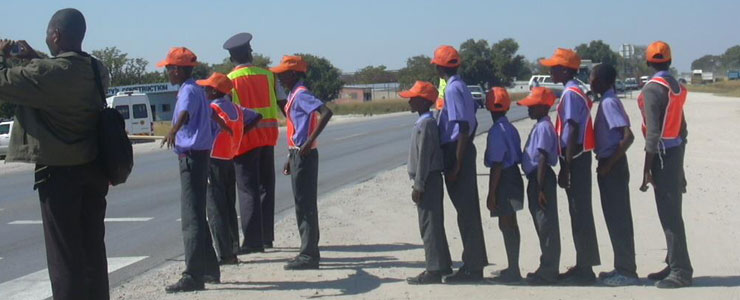
The National Road Safety Council (NRSC), together with the Ministry of Works and Transport and key road safety stakeholders, officially launched the United Nation Global Road Safety Week campaign on Friday, 15 May 2026, at Dr Agostinho Neto Square in Windhoek under the global theme, “Make Walking and Cycling Safe.”
This launch advances Namibia's Second Chapter of the Decade of Action for Road Safety 2021–2030, launched under Government leadership in March 2021. It brings our national efforts in line with global goals for safer roads, vehicles, and road users, with a special focus on protecting pedestrians and vulnerable groups through proven, practical steps.
The launch brought together government institutions, law enforcement agencies, international organisations, civil society, faith-based organisations, cyclists, runners, and members of the public to raise awareness on the importance of protecting vulnerable road users such as pedestrians and cyclists. Speaking at the event on behalf of the Minister of Works and Transport, Executive Director Mr. Jonas Sheelongo highlighted the importance of creating safer and more sustainable transport systems in Namibia. According to the latest report the first four months of the year has resulted in 1033 crashes which resulted in 1 709 injuries and 179 fatalities, as per the MVA Fund’s statistical data report. In comparison to the same period of 2025, these key variables have each declined in percentage: crashes have reduced with 6%, whereas injuries have reduced with 9% and fatalities have reduced with 6%. During the occasion, he officially launched the study titled “Towards Policies and Interventions for Non-Motorized Transport in Small and Medium-sized Urban African Towns: The Namibia Case.”
The study revealed that non-motorised transport, particularly walking and cycling, accounts for more than 70 percent of daily travel for many low-income households, emphasizing the urgent need for safer infrastructure, improved urban planning, and dedicated policies for pedestrians and cyclists.
The World Health Organization (WHO) Representative in Namibia, Dr Richard Banda, stressed that road safety remains a major public health concern globally and in Africa. He noted that road traffic crashes claim approximately 1.19 million lives every year worldwide, while vulnerable road users account for more than half of all road traffic deaths. Dr Banda further emphasized that walking and cycling are among the healthiest, most affordable, and most sustainable forms of transport, yet many roads still lack proper pedestrian crossings, sidewalks, lighting, speed control measures, and dedicated cycling lanes. He called for stronger investment in safer infrastructure, lower speed limits, stronger law enforcement, and improved post-crash care through the Safe System Approach.
Chairperson of the National Road Safety Council, Deputy Commissioner (Rtd) Amalia Gawanas, said the commemoration serves as a reminder that road safety is a shared responsibility requiring collaboration between government, communities, civil society, the private sector, and international partners.
She further highlighted the importance of the United Nations Second Decade of Action for Road Safety 2021–2030, which aims to reduce road traffic deaths and injuries by at least 50 percent. She encouraged regional and local authorities to prioritise safe road infrastructure and sustainable mobility for all road users. As part of the week’s activities, the NRSC hosted a 5-kilometre walk and a 10-kilometre run on Saturday, 16 May 2026, to promote safer roads, and awareness on pedestrian and cyclist safety. Hundreds of participants from various sectors, including community members, runners, cyclists, and stakeholders, took part in the activities in solidarity for safer roads in Namibia.
The campaign concluded with renewed calls for collective action, responsible road use, improved infrastructure, and stronger partnerships to ensure safer mobility and protect lives on Namibia’s roads.